Halic: A Decorative Display Font That Sells Your Craft
As someone who hand-presses greeting cards, cuts vinyl for boutique tags, and designs printable wedding suites for Etsy sellers, I know how much a font can make—or break—a product’s first impression. Halic isn’t just another decorative font—it’s the kind of typeface that stops scrollers mid-feed, makes customers pause at your booth, and turns a simple candle label into something people photograph and tag. It’s bold without shouting, artistic without sacrificing clarity, and expressive enough to carry emotional weight—whether you’re naming a lavender-scented soy candle or welcoming guests to a rustic barn wedding.
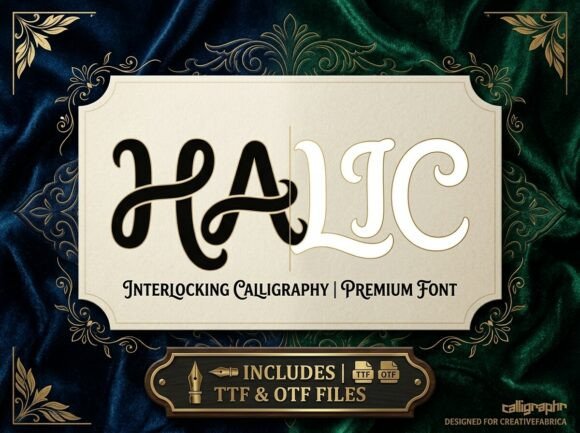
Halic lives in the sweet spot between craftsmanship and commercial readiness. Its letterforms feature subtle calligraphic rhythm, gentle contrast in stroke weight, and carefully considered terminals that give it warmth and intentionality—not the stiff uniformity of over-digitized scripts, nor the chaotic flair of unreadable display fonts. The capitals have presence; the lowercase letters retain charm while staying legible even at 24pt on a printed sticker. It’s not meant for body text—but then again, neither is your hand-stamped tea towel tag or your acrylic welcome sign. Halic shines where attention matters most: headlines, names, titles, and short, high-impact phrases.
I’ve used Halic across real production workflows—and here’s what works:
- Candle & soap labels: Paired with a clean sans serif (like Montserrat or Inter) for ingredients and weight details, Halic gives artisanal products instant credibility. On kraft paper labels, its texture reads as hand-drawn—even though it cuts cleanly on Cricut and Silhouette machines.
- Wedding stationery: “Alex & Taylor” in Halic on an ivory invitation sets tone before the guest reads a word. Its balanced spacing prevents crowding on RSVP cards, and the strong x-height ensures readability when printed small on envelope liners or place cards.
- Farmhouse signs & wall art: Whether laser-cut from birch plywood or printed on archival matte paper, Halic holds up beautifully at larger sizes. Its vertical stress and open counters prevent visual “blobbing” when scaled to 12+ inches—critical for porch signs or nursery prints.
- Digital printables & planner pages: As a title font in Canva or Affinity Designer, Halic adds premium polish to downloadable planners, habit trackers, or seasonal checklists—without slowing down load times or causing rendering glitches on mobile previews.
- SVG bundles & craft templates: Because Halic includes standard OpenType features like ligatures and stylistic alternates, you can offer multiple design variants (e.g., “Happy Birthday” with or without swash caps) in one file—great for bundling on Etsy or Gumroad.
Readability matters—not just for eyes, but for machines. Halic exports cleanly as OTF and TTF, with well-hinted outlines that render crisply at small sizes on printed cards and stickers. I tested it down to 14pt on matte-finish sticker paper: no broken serifs, no clipped terminals. For vinyl cutting, I recommend avoiding the most ornate alternates on sub-20mm text—but the base character set cuts flawlessly on both Cricut Maker 3 and Silhouette Cameo 4. Just remember to convert to outlines before exporting SVGs if you’re selling cut files.
Pairing Halic thoughtfully multiplies its impact. Think of it as the “hero” in your typographic cast:
- With a neutral sans serif: Use Halic for “Wildflower Co.” and Inter Bold for “Small-Batch Herbal Teas”—clean hierarchy, modern brand identity, zero visual competition.
- With a soft serif: Try Halic for “Est. 2021” alongside Lora Italic for a handwritten note on a boutique gift tag. The contrast feels intentional, not accidental.
- Avoid pairing with other decorative fonts: Two display fonts in one layout dilute focus. Let Halic lead—and let supporting type recede gracefully.
If you’re sourcing fonts for client work, digital downloads, or physical goods, licensing is non-negotiable. Halic is a commercial font—meaning you’re fully covered to use it in logos, packaging, social media graphics, client presentations, and unlimited physical product runs (think mugs, tote bags, apparel). You may also embed it in PDF templates or sell editable Canva versions—as long as end users aren’t granted license to extract and redistribute the font file itself. Always verify the license terms included with your purchase, especially if offering SVGs or layered PSD files.
What sets Halic apart from other decorative fonts isn’t just its aesthetics—it’s how it behaves in the real world of making. It doesn’t require endless kerning adjustments to look right on a 2” product tag. It doesn’t pixelate in mockups shared via Instagram DMs. It doesn’t confuse your cutting machine’s auto-trace. And because it avoids extreme flourishes or ultra-thin strokes, it translates reliably across mediums: screen, inkjet, laser, foil stamp, and even embroidery digitizing (when used sparingly for monogram accents).
For printable creators, Halic elevates perceived value instantly. A $7 digital quote poster feels like a $25 art print when set in Halic on textured background paper—especially when paired with thoughtful line spacing and margin breathing room. For sticker designers, it transforms basic affirmations (“You Are Enough”) into collectible moments—rounded out by consistent baseline alignment and generous letterfit that prevents awkward gaps between words.
Seasonal projects benefit too. Halic’s grounded yet graceful proportions work equally well for cozy autumn harvest tags (“Pumpkin Spice & Everything Nice”), crisp winter holiday packaging (“Hand-Poured • Small Batch • Made With Love”), and airy spring invitations (“Gather • Grow • Celebrate”). Its versatility comes not from being generic—but from having clear, confident personality that adapts to context instead of overwhelming it.
At the end of the day, fonts are tools—not ornaments. Halic earns its place in my core design kit because it delivers on both beauty and function: it attracts, communicates, and converts—without asking me to compromise on production speed, file stability, or customer expectations. If you’re choosing a decorative font to represent your handmade brand, your printable shop, or your next best-selling SVG bundle—choose one that does more than look pretty. Choose one that helps you sell.